

In January 2024, Ivanti disclosed two CVEs in their Connect Secure and Policy Secure VPN appliances. CVE-2023-46805 was an authentication bypass. CVE-2024-21887 was an unauthenticated command injection: a remote shell on a box that, by design, had to be reachable from the public internet. Mandiant attributed the in-the-wild exploitation to UNC5221, a suspected Chinese state-sponsored cluster. By the time Ivanti shipped a patch, Mandiant had identified more than a thousand compromised appliances. CISA issued Emergency Directive 24-01 telling every U.S. federal agency to take their Ivanti boxes offline.
This is part 6. Earlier parts covered npm (Part 1), GitHub Actions (Part 2), the unsexy infrastructure list (Part 3), DNS auth records (Part 4), and the dev laptop perimeter (Part 5). Part 6 is the network in front of everything. What sits between your engineers and prod, and between prod and the public internet.
The thesis from Part 1 stands. Future You at 3am will not patch a VPN concentrator the same week the CVE lands, especially when the vendor patch breaks LDAP for half the team. The architecture that makes the concentrator irrelevant is the one that runs while you sleep: a mesh network where there is no internet-facing appliance to compromise in the first place.
the VPN appliance is the attack surface
The Ivanti CVEs are not a unique event. They're the most recent member of a class. The same year (2024) saw:
- Cisco ASA / FTD: CVE-2024-20353 + CVE-2024-20359. A web-services DoS and a persistent local code-execution flaw used together by the ArcaneDoor campaign (Line Dancer / Line Runner implants), attributed by Cisco Talos to state-sponsored actors. April 2024.
- Citrix NetScaler "CitrixBleed": CVE-2023-4966. A session-token leak via memory disclosure, exploited by LockBit and others, used in the Boeing and Comcast breaches.
- Fortinet FortiOS SSL VPN: CVE-2024-21762. Out-of-bounds write in February 2024, exploited in the wild before patches were widely deployed.
- Palo Alto Networks GlobalProtect: CVE-2024-3400. Command injection in April 2024, exploited in a campaign Palo Alto Networks Unit 42 named Operation MidnightEclipse (Volexity tracks the actor as UTA0218).
Five different vendors. Five different products. Five different attacker campaigns. The common shape is a publicly reachable HTTPS portal that handles authentication and tunnel termination. Every one of them has had a pre-authentication remote code execution in the last twelve months. That isn't a coincidence; it's an architecture.
What mesh networks (Tailscale, Cloudflare Access, Headscale, native WireGuard) don't have is an internet-facing login portal. The control plane authenticates over the same OIDC/SSO your engineers already use; the data plane is WireGuard between authorized peers; there is no single box that, if compromised, lets the attacker into the rest of the network. The lazy stance is: don't run a VPN appliance. Every use case has a mesh-or-proxy answer that ships with less attack surface and less operational pain.
Tailscale for outbound
The fast path: install the daemon on every machine you want to access from, and every machine you want to access. Each daemon authenticates against your IdP. Within sixty seconds, every node in your tailnet can reach every other node over WireGuard, with private IPv4/IPv6 addresses inside the tailnet.
Replace ssh user@bastion.yourorg.com with tailscale ssh user@prod-db.your-tailnet.ts.net. Replace grafana.yourorg.com (publicly reachable, gated by a Cloudflare IP allowlist that nobody can remember the source of) with grafana.your-tailnet.ts.net (only reachable to tailnet members, no public DNS record, no public route).

Fig. 2 · twenty lines of HuJSON beats two hundred lines of iptables, and you can git diff the change.
The ACL itself, in HuJSON (JSON with comments, native to Tailscale):
{
  "tagOwners": {
    "tag:prod-db":  ["group:platform"],
    "tag:internal": ["group:platform"]
  },
  "groups": {
    "group:platform":  ["[email protected]", "[email protected]"],
    "group:engineers": ["group:platform", "[email protected]"]
  },
  "acls": [
    // Engineers can reach internal HTTP services.
    { "action": "accept", "src": ["group:engineers"], "dst": ["tag:internal:80,443,3000,8080"] },
    // Only platform can reach prod databases.
    { "action": "accept", "src": ["group:platform"],  "dst": ["tag:prod-db:5432,6379,9200"] }
  ]
}
Twenty lines of declarative policy. Each change is a PR. Each merge is reviewed. Each rule is a sentence a human can read in three seconds. The version of this living in iptables is two hundred lines that nobody touches because nobody knows whether the bottom forty are still load-bearing.
Cost: under Tailscale Pricing v4 (April 2026), Free covers up to 6 users and 100 devices. Paid plans are Standard at $6/user/month, Premium at $18/user/month, and Enterprise above that. For a 15-person team, $90/month on Standard buys SSO, audit logs, and ACL change history.
Cloudflare Tunnel for inbound
Different shape of problem. You have a service that needs to be reachable to specific users (employees, customers, a vendor's support team) but should never have a public DNS record. The wrong answer is putting it on the public internet with an IP allowlist. The right answer is Cloudflare Tunnel.
The architecture: cloudflared runs on the origin and dials outbound to Cloudflare's edge. There is no inbound port. The origin has no public IP. Cloudflare Access (the policy layer) sits in front of the URL and requires the user to authenticate via your IdP (Google, Okta, GitHub, OneLogin, generic OIDC) before the request is proxied to the origin.
# On the origin
cloudflared tunnel login
cloudflared tunnel create vendor-admin
cloudflared tunnel route dns vendor-admin admin.yourorg.com
cloudflared tunnel run vendor-admin
Three commands of consequence. The vendor admin panel is now reachable at admin.yourorg.com, gated by your SSO, with no public route to the underlying service. Add Cloudflare Access policy rules (a few clicks in the dashboard or a Terraform resource) to require a specific Okta group, a specific email domain, a specific device posture, or an mTLS cert.
Cost: Cloudflare Zero Trust Free covers up to 50 users. $7/user/month above that. The Tunnel daemon itself is free; the metering is on Access seats.
WireGuard, when you can't run Tailscale
For the regulated, air-gapped, or contract-forbids-SaaS case, WireGuard has been in mainline Linux since kernel 5.6 (March 2020) and is enabled by default in most distros. The configuration is plain text. The minimum viable setup is about twenty lines per peer.
# /etc/wireguard/wg0.conf, on the server
[Interface]
Address = 10.7.0.1/24
ListenPort = 51820
PrivateKey = <server-private-key>

[Peer]
PublicKey = <engineer-public-key>
AllowedIPs = 10.7.0.2/32# On the engineer's laptop
[Interface]
Address = 10.7.0.2/32
PrivateKey = <engineer-private-key>
[Peer]
PublicKey = <server-public-key>
Endpoint = vpn.yourorg.com:51820
AllowedIPs = 10.7.0.0/24, 192.168.10.0/24
PersistentKeepalive = 25wg-quick up wg0 and the tunnel is live.
The pain at scale is peer management. Twenty engineers means twenty keypairs, twenty AllowedIPs blocks on the server, and a manual re-deploy each time someone joins or leaves. Two OSS tools fix that: Headscale, which is a Tailscale-protocol-compatible control plane you self-host (same Tailscale clients on each device, but the coordination server is yours); and wg-easy, a small web UI for adding and removing peers. Both give you the Tailscale UX with none of the SaaS dependency.
When to pick this path over Tailscale: your contract forbids data-plane traffic transiting a U.S. SaaS, you operate in a region where Tailscale can't legally provide service, or you're regulatory-bound to run the full stack yourself. Otherwise, Tailscale Standard at $6/user/month is a better use of a platform engineer's time than peer management cron jobs.
the ACLs you can actually read
The reason the appliance era was painful wasn't just the CVEs. It was the iptables rulesets nobody read.
-A INPUT -m state --state RELATED,ESTABLISHED -j ACCEPT
-A INPUT -i lo -j ACCEPT
-A INPUT -m state --state NEW -m tcp -p tcp -d 10.0.1.5 --dport 22 -s 10.0.0.0/24 -j ACCEPT
-A INPUT -m state --state NEW -m tcp -p tcp -d 10.0.1.5 --dport 5432 -s 10.0.0.50/32 -j ACCEPT
-A INPUT -m state --state NEW -m tcp -p tcp -d 10.0.1.6 --dport 6379 -s 10.0.0.50/32 -j ACCEPT
# ... 200 more lines, no comments, no group names, no diff history
versus the Tailscale ACL above. Twenty lines of declarative policy, with group names that mirror Okta groups, with comments that say what each rule is for, version-controlled in git. The same is true for Cloudflare Access policies (declarative JSON, also Terraform-supported), Headscale ACLs (the same HuJSON Tailscale uses), and even WireGuard's AllowedIPs per peer (one line per route per peer).
If the only person who can read your firewall rules is the person who wrote them three years ago, that is a security problem, not just an operations problem. The audit answer "what does the prod network allow?" should be a git log and a code review, not a screen-share with the senior engineer who took notes on a sticky.
the receipts
For 15 engineers, the network-in-front-of-everything bill:
- Tailscale Standard at $6/user/month: $90/month for 15 engineers. Covers SSH-to-bastion, internal HTTP access, prod database access, MagicDNS, ACL audit logs. The primary line item.
- Cloudflare Zero Trust Free (<50 users): $0. Replaces public-internet vendor portals, internal-with-SSO web apps, customer-facing internal tools.
- Self-hosted WireGuard or Headscale: $0, plus a small VPS for the control plane if needed (~$5/month). For the use case Tailscale can't legally cover.
- The retired VPN appliance contract: somewhere between $5K and $50K per year, depending on vendor and seat count, going back into your budget when the contract ends.
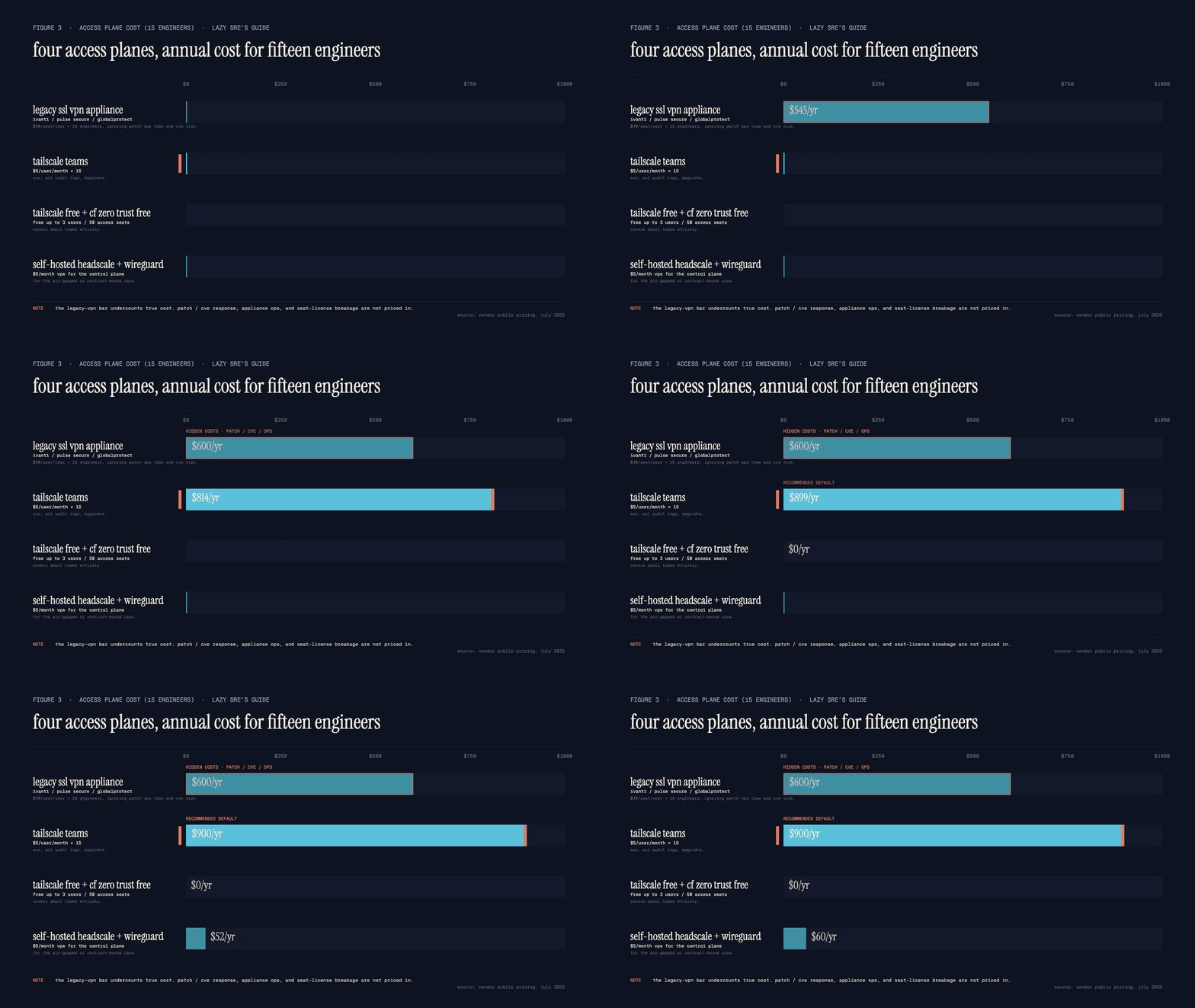
Fig. 3 · the bottom two bars are not an emergency, the top bar is.
Net cost: $90/month for the access plane covering most of the surface, with optional fallbacks at near-zero cost. For comparison, the median per-seat price of a legacy SSL VPN appliance (Pulse Secure / Ivanti, GlobalProtect, AnyConnect) at small-business pricing is around $40/seat/year, or roughly the same number, without the CVE risk and without the iptables ruleset.
What this catches: every internet-facing VPN appliance CVE, because you don't have one. Every "the bastion's security group was opened to 0.0.0.0/0 to debug a contractor's IP last summer and never closed" incident, because the bastion isn't reachable. Every "the static VPN certificate leaked from a contractor's laptop" incident, because the credential is a short-lived OIDC session, not a long-lived cert.
What it doesn't catch: a compromise of your IdP itself. If an attacker controls Okta, they control your tailnet. (Cloudflare's Thanksgiving 2023 incident report, attributed to Okta's October 2023 support-system breach, is the canonical reference for this failure mode and the response.) The mitigation lives in Part 3: FIDO2-only admin access on the IdP, audit log streaming, and a runbook for "rotate all sessions in five minutes."
If you do one thing this week, install Tailscale on your laptop and one prod host, get them talking over the tailnet, and replace one ssh bastion.yourorg.com invocation with tailscale ssh prod-host. Cost: zero. Time: ten minutes. Then plan the rest of the rollout for next quarter, when you have the budget conversation with whoever still pays for the SSL VPN renewal.